
John 14:15 • If We Love Him

During a speech she gave at an event I attended five months ago, a friend made a request as a passing remark in an illustration she was using. But earlier this week, I had the opportunity to fulfill that offhand request, and I did it while quoting what she’d said on that occasion word for word. When I did, she responded incredulously saying, “You were listening,” and I answered, “Of course, I was.”

I did what I did and said what I said because one of the primary ways we honor others is by listening to them, and not just to hear their words, but to understand what they meant and, more importantly, how to be responsive to them. For instance, although it took me longer than it should have, over the years of our marriage, I discovered the importance of expressing my love for my wife by being fully present when she has something to say, asking clarifying questions to make certain I’m truly understanding her, and then being careful to respond with appropriate action.

So, I get what Jesus was saying to his disciples in John 14:15. He was trying to help them understand that the affection they had for him should result in obedience to all he’d taught them. And since that clearly applies to us too, let’s make sure our sincere loving translates into deep listening and careful doing. And let’s make sure we engage in that process beginning right here with this verse by paying close attention to what he meant. To do that, we need to take a closer look at some of the words he used.

By beginning with the conditional particle if, he wasn’t questioning the sincerity of his followers’ love but the type. The word translated as love in this verse is the one the New Testament uses almost exclusively to describe the kind God has. It’s a sacrificial love defined more by what it does than what it feels. Oh, it’s replete with feelings, but it’s not satisfied until those feelings motivate a costly offering of itself. Jesus wasn’t demanding action as proof of their love. Instead, he was inviting them into the kind of love that results in action.

Then, there’s the word translated here as keep. The original Greek is less about doing as instructed and more about how those instructions are valued. It’s not describing obedience for the sake of obeying, the kind required of a servant. It refers to the sort of careful attention and diligence one gives to carrying out the directions of someone held in highest regard like the requests of a dear friend.

And that’s what’s at the heart of this profound, one-sentence verse of Scripture. Jesus wasn’t acting like an immature teenager saying, “If you really loved me, you would do what I say.” He was welcoming those closest to him into a deeper form of relationship. In fact, being responsive to the loving commands of our precious Savior is so tightly integrated into the fabric of the kind of relationship he wants with us that it’s an indispensable part of what defines it. 1 John 2:3 says, “Now by this we know that we know Him, if we keep His commandments.”

So, I think this is probably an appropriate moment to evaluate how responsive we are to the Lord’s commands. And if that reflection reveals an approach that’s more casual than careful, we need to be honest with ourselves about what that might be saying regarding the nature of our love for him. But the beauty of John 14:15 is that it extends to all of us the opportunity to enter a deeper way of knowing him, one that naturally produces an obedience born of true affection.


John 14:12-14 • His Anything Promise

In my early twenties, I was hired by a company that installed solar pool heaters. But I quit after only a few weeks because they repeatedly sent me out in the company truck to do installations without first ensuring that it was stocked with the parts, tools, and supplies I would need for the job. I’d show up at the homeowner’s property as an authorized representative of the company but without the resources to fulfill anyone’s expectations. It was embarrassing for me, disappointing for the client, and shameful for our firm. So, it shouldn’t be a surprise when I tell you the business went bankrupt soon after I resigned. But I think that episode in my employment history may help us better understand something very important Jesus taught his disciples in John 14:12-14.

He’d just validated the importance of displays of his miraculous power as pathways to faith by inviting Philip to a belief based on his works. Then, he used that invitation as a bridge to introduce another of the truths he wanted to equip his disciples with as he prepared them for the aftermath of his cross and resurrection.

He told them their faith would enable him to dispense miracles through them. In fact, he said they would be vessels for even greater works than they’d seen him perform precisely because he would be ascending to the father. And although his reference to greater works was surely not about magnitude – they’d seen him raise Lazarus from the dead, for goodness’ sake – it was about quantity. He was describing the multiplying impact that would result when his physical presence was no longer a limiting factor, and he could, from the platform of his heavenly glory, pour out his power through all his followers.

And if that statement wasn’t mind-blowing enough, he followed it with a real zinger. Jesus told them that he would do anything they asked in his name and that his Father would be honored as a result.

Did he really mean that?

I think it’s clear he did, but I also think it’s clear that we need to be careful not to misinterpret what he said. He wasn’t giving his followers a blank check to receive whatever they desire if they just remember to close their prayers with a certain phrase. He was being very specific about two things that were prerequisites for the fulfillment of his anything promise.

First, praying "in Jesus’ name" does not mean using that phrase as a kind of spiritual incantation to unlock God’s favor. It means that our requests flow out of and are in sync with our assignment to serve as his representatives. Unlike my former employer, when we're acting as his agents or in his name, we are never under-resourced. He has promised to provide all that’s needed.

Second, Jesus said the kind of request that unleashes his miraculous response is the kind that's focused on glorifying the Father. Whenever we approach God in prayer, it’s wise to consider the motives behind what we ask of him. It’s important to honestly confront any selfishness and align our motives to reflect honorably on him.

Are these just caveats that let God off the hook or provide him an excuse when we don't experience the miracles we ask for? Absolutely not! The Lord of Glory prefaced his promise with the phrase, “Most assuredly, I say to you.” And that's an expression that means nothing is more true than this. He went on the record with a pledge we can absolutely count on. And that means you can trust him to do anything you ask in his name.

John 14:7-11 • To be With or to Know

My wife and I have been married nearly fifty years, but we almost didn’t make it past ten. At that point, Sue walked out on me and had every right to. I was so controlling and self-absorbed that although I’d been with her for a decade, I didn’t really know her. I’d never sufficiently invested my heart in the pursuit of discovering, celebrating, learning from, and being changed by the rich treasure of who she is. And the loss of those first years, is the deepest regret of my life. But the grace of God and her willingness to forgive gifted me with a second chance. And in the years since, as the Holy Spirit has been healing my brokenness, it’s become my heart’s delight to daily explore and marvel at the wonders of this luminous creature I’ve been blessed to share life with. I love the adventure of getting to know her.

And that experience informs how I approach John 14:7-11. At its heart, is a searing question. Jesus asked, “Have I been with you so long, and yet you have not known Me, Philip?”

Jesus had just highlighted another of the essential understandings the disciples would need in preparation for his ascension. He’d restated something they’d heard him refer to many times. He reminded them that through the testimony of his life, they’d been able to see the Heavenly Father.

So, it must have been quite jarring when Philip, sounding as though he’d completely ignored Jesus, responded by saying, “Show us the Father.” And it was this bizarre request that prompted the Lord to reply with the poignant and haunting query that although addressed to Philip, needs to be wrestled with by every Christ-follower. It challenges us all to consider whether we’ve been satisfied to simply be with Jesus or committed to getting to know him.

You can hear the heartache in the Lord’s voice as he lamented Philip’s failure to grasp the truth that defined the core of his being. He and the Father are one. If Philip hadn’t cared enough to get to know that about him, it called into question the genuineness of his faith and the depth of their relationship. So, he implored Philip to either believe what he’d taught him or at least what his works demonstrated about it.

But there’s a big difference in those avenues to faith. The first is based on communication – what Jesus said. The second is based observation – what Jesus did. The first involves a choice rooted in Jesus himself, the second on evaluated evidence about him. They both arrive at belief, but the first is personal the second empirical. The first is a more direct route to relationship. The second requires an intermediate step. And that’s why Jesus offered it to Philip only as an alternative. His priority is always to welcome us deeper into relationship. He wants us to know him.

Has your faith-journey become more pragmatic than intimate? Has it devolved into an arrangement that’s more like just being with Jesus than getting to know him? If so, that can change right now. Let me remind you of the Lord’s promise in Revelation 3:20 where he said, “Behold, I stand at the door and knock. If anyone hears My voice and opens the door, I will come in to him and dine with him, and he with Me.”

That offer is not just for the day you first responded to his loving grace. It’s also for every day that follows including this one.

John 14:4-6 • Two Sentences

In the final hours before his crucifixion, Jesus remained focused on making sure his disciples were ready. And in John 14:4 he summarized a couple of the critical understandings they’d already received by stating that they knew where he was going and how to follow him there.

But in verse 5, Thomas took issue with that.

Now, it’s clear Jesus wasn’t wrong in his assessment of what the disciples knew. Thomas was just giving voice to a fierce, internal struggle that was preventing them from acknowledging what they’d been taught. They didn’t want their Lord to leave them, so they resisted accepting what he’d told them about it. It’s pretty easy to hide things from ourselves when they have to do with something we don’t want to know.

In verse 6, Jesus responded to Thomas’ rebuttal with two of the most direct and consequential sentences in the whole Bible. Using the definite article, he said he was the way, the truth, and the life. Then, referring to what he’d previously said about his return to the Father’s house, he declared himself the only means of accessing that glorious presence.

His choice of words was strategic. He was unambiguous. He couldn’t have been clearer. He said a relationship with God is only accessible through him, declared himself to be the exclusive revelation of truth, and claimed to be the sole source of life. And this creates a big problem for anyone who wants to assert that Jesus is only one of many ways to reach God, interpret truth, or pursue life. To believe that, you have to attribute what he said to arrogance, self-delusion, or egocentrism. And none of those things can reasonably be ascribed to Jesus.

We live in an age of deeply embedded relativism. Absolutes are roundly rejected. So, like Thomas and the other disciples attempting to hide unwanted knowledge from themselves, some people are predisposed to ignore Jesus’ emphatic self-definition. But these two sentences of his own words push back forcefully and unapologetically against the idea that there’s flexibility in what we choose to think about who he is. There’s not. His statements crowd us either toward belief or unbelief. There’s no wiggle room.

If you’re looking for a back door to heaven, seeking to reshape truth to fit your paradigm, or hoping to carve out a life that straddles the spiritual fence, don’t bother trying to somehow shoehorn Jesus into those pursuits. You’re on your own.

He’s either who he said he is or he’s not. If he’s not, we’ve got to be honest with ourselves about that and stop the foolish pursuit of looking to him for anything of value. But if he is who he said he is, then we need to be honest with ourselves about that and stop looking to anyone or anything else for what only he can supply.

John 14:2-3 • A Big Remodeling Project

A few years ago, my wife and I inherited the little house she grew up in near the beach in Southern California, and we decided to make it our home in retirement. So, we embarked on a big remodeling project. The house had seen better days and needed lots of repair work. But because we also wanted to have room for our kids and their families to visit, we added two bedrooms to make a total of four.

Scattered among those rooms are three sets of bunkbeds to accommodate all the grandkids. And each of the bunks has its own corkboard mounted to the wall next to it so the little ones can use pushpins to hang their drawings or whatever they like to create a personalized space. We want them to know they were planned for, their presence is desired, and that within our house, each of them is at home.

In John 14:2-3, Jesus continued helping his disciples process the announcement of his imminent departure by giving them a small glimpse into the eternal destiny it would secure for them. He said he’d be leaving to prepare a place for them within his Father’s house. And although I don’t think it’s possible within the limited framework of human understanding to fully grasp the preparations the Lord said he needed to accomplish in advance of the fulfillment of that promise, it’s clear they included the forgiveness of sins purchased with his crucifixion (John 1:29), the spiritual rebirth made available through his resurrection (John 3:3), and the indwelling of the Holy Spirit made possible by his ascension (John 16:7). But he told them that with everything prepared, he would one day return to escort them into that spiritual home they would share with him.

English versions of the Bible use the words mansions, rooms, or dwellings to translate the Lord’s description of this destination. But a more literal translation of the Greek would be something like a staying or abiding. Jesus was not saying his Father’s house contains a large number of individual suites. He wasn’t describing a place made up of many compartments. He was talking about an environment of belonging. He was using language that pointed toward the residing that happens in the Father’s residence. He was saying they would be at home in God’s house. He specifically avoided giving them details about the place – which they would have had no frame of reference to understand anyway – and focused their attention on what was most important: They would dwell with him.

These words of comfort and promise were not meant exclusively for the handful of followers with him on that night of his betrayal. Set within the context of the whole of Scripture, it’s clear Jesus was speaking beyond them and that moment to all who would follow him throughout history. And that includes you and me. The Savior wants us to know that his salvation project has remodeled heaven to make room for us. We were planned for, our presence is desired, and within his house, each of us will be at home.

John 14:1 • Separation Anxiety

I recently had the chance to babysit one of our grandsons. His dad was out of town, and his mom had an appointment to keep. So, I happily stepped in to watch him for the couple of hours she’d be away.

He and I have a great relationship, and I know he loves and trusts me. But after about an hour, he got teary-eyed and said he missed his dad. I know part of it was just that he was tired and hungry. But I also know that separation anxiety is a real thing. And with his mom’s comforting hug temporarily unavailable, my reassurance that his dad would be home in just a couple of days wasn’t enough. His little heart was troubled.

That word is in the first verse of John 14, and I’ll bet you know what it means without me telling you. It’s not something just kids go through. You’ve experienced it yourself. But for the record, it’s translated from a Greek word meaning to be fearful, distressed, agitated, restless, perplexed, stirred up, or in pain. And I want to suggest that when we feel that way, a similar kind of insecurity is at its root. We become vulnerable to it when our circumstances conspire to make us feel God is distant and his comfort unavailable.

As Jesus continued to prepare the disciples for his crucifixion, resurrection, and return to the Father, he addressed the separation anxiety he knew they could experience when he was no longer physically with them. And he told them exactly what to do whenever their hearts were troubled. He told them to believe.

It’s important to note the Lord used the verb form of the Greek word for faith here. He didn’t use the noun which would have referred to a thing that exists. The belief they possessed wasn’t the antidote for their troubled hearts. The act of believing was. There’s a big difference. Faith is like having a house key on your ring. But it won’t get you inside unless you put it in the lock and give it a turn. Jesus was teaching them that dealing with a troubled heart would require more than having faith. It would require exercising it. And the same is true for us.

Christ-followers have crossed the threshold from doubt into faith. We possess belief. But you’ve already discovered that that faith doesn’t mean we won’t experience spiritual separation anxiety. Trying times that blunt our sense of the Lord’s presence and tempt us to feel alone to face them call for the verb from of our faith.

My grandson knew I wasn’t lying to him about his dad’s return. But in his distress, the faith he has that I would never deceive him proved insufficient to deal with the ache in his heart. He needed to make a choice to actively trust me in that moment. And in the same way, our times of struggle always provide us with the opportunity to exercise the faith we have in the love of Jesus by choosing to believe in him.

Is your heart troubled? Are you fearful, distressed, agitated, restless, perplexed, stirred up, or in pain? Does it feel like you’re somehow on the outside looking in on the Lord’s comforting presence? Put the key in the lock and give it a turn. Make the choice to actively trust your Savior’s love right now.

John 13:36-38 • An Even-After-You-Do Covenant

John 13 is a dense narrative, but part of it reveals Peter struggling to understand. He had trouble comprehending why Jesus wanted to wash his feet. Then, he was confused about which of the Twelve would become the Lord’s betrayer. And in verses 36-38, the chapter concludes with an account of what may have been his most significant dilemma.

Jesus had just finished reminding his disciples he would soon be leaving them. And although he’d previously said, more than once, he’d be returning to the Father, Peter responded by asking where he was going. It seems like Peter was suffering from a case of selective listening, that condition that affects so many of us and causes us to hear only what we want to hear. It’s as though he just didn’t want to deal with the Lord’s departure, so he blocked it out until the imminence of it suddenly broke through, and his thoughts were trying to catch up.

Jesus answered him by restating what Peter had already twice heard him say to the religious leaders (John 7:34; 8:21). He’d told them he was going somewhere he couldn’t be followed. But this time, in his direct response to Peter, he added the word now. In stark contrast to what he’d said to the Scribes and Pharisees, the addition of that one word unveiled a spectacular promise. He told Peter that although he couldn’t follow him now, he would later.

And the significance of that statement is beyond profound, it’s life-altering. When the moment arrives that, by faith, we accept the truth that his cross, resurrection, and ascension open the way for us to step across the sin-divide and be with Jesus eternally, everything about our lives on this side of that threshold changes. We begin to enjoy a seamless daily relationship with him no longer throttled by the limits of time. Forever has already begun.

But based on his follow-up question, it’s doubtful Peter understood all that. He just wanted to know why he couldn’t come now. And he claimed he should be allowed to because he was willing to lay his life down for the Lord. So, when Jesus questioned that commitment and announced that before the night was over he would fail to live up to it, it must have devastated Peter.

But as hard as those words would have been to hear, I believe they were an expression of grace. Perhaps more than any other prior exchange he’d had with Jesus, this could have been the one that marked the trail for him back from that terrible night when he denied knowing the Lord three times.

In the aftermath, he would have finally begun to understand. The promise that one day he would follow Jesus into the precincts of heaven was made with the Lord’s foreknowledge of his pending failure. And it wasn’t qualified with an if-you-don’t clause. It was given as an even-after-you-do covenant. And as the fog of his failure was clearing, he would have also realized his eternal destiny could never be based on his willingness to lay his life down for Jesus. It could only be secured because Jesus was willing to lay his life down for him.

John 13:33-35 • Little Children

I can’t know if it’s the same for you, but my social media feeds are typically saturated with photos and videos of my friends’ children and grandchildren. From infants asleep in their cribs to toddlers taking their first steps to grade schoolers playing soccer to high schoolers dressed for prom, they just can’t seem to help themselves. They’ve fallen head-over-heels in love with these sweet gifts from God and imagine everyone else in the world will too if they can just get a glimpse of their little lovelies mugging for the camera.

And something of that kind of deep parental devotion is heard in the voice of Jesus when in John 13:33-35 he addressed his little children. It’s a two-word translation of a single Greek word used only this once in the four Gospels and only sparingly in the rest of the New Testament. It’s a term of rich endearment like those a new mom might use to caption the latest pic of her little darling posted on Instagram. And if you’ve ever felt that kind of pride, delight and affection for your own child or been loved by a parent in that way, this expression is meant to help you sample a small taste of how the Savior feels about you.

But the magnitude of the awareness that we’re loved like that by the Lord of Lord’s can be difficult to take in. So, we generally choose to deflect its impact by imagining that this salutation is either exclusive to the disciples or thinly spread in a diluted way across all believers. It’s a challenge to allow ourselves to be enveloped by the full measure of the truth that Jesus, with detailed knowledge of our faults and failings, loves us as his dear children. And yet, here he is. The one who spoke the universe into existence is calling to each of us from this passage with tender words of equal power intended to secure our souls in the embrace of his compassion. How dare we resist!

Unless we stop disqualifying ourselves and make the choice to fully rest in the warmth of his affection, we won’t be able to fulfill the command he issued in this passage. He reminded his followers that he would not be physically present with them much longer. Then, he assigned them to be his ambassadors, and he told them to do that by loving others in the same manner he’d loved them.

He said this was a new commandment. Among the laws God gave Moses for the Israelites in the Old Testament was: “You shall love your neighbor as yourself” (Leviticus 19:18). But now, Jesus was saying that to be his representatives in this world, it would not be sufficient to love others as ourselves. It would require loving others more than ourselves. It would mean learning to love like he loves. And the only way that can even begin to be possible is if we first personally experience it.

Until we stop letting the haunting awareness of our unworthiness keep us from living life fully enveloped within his love, we won’t be able to offer it to others. But if we take the risk of a freefall into his waiting arms and permit him to break the cycle of shame that feeds our hesitation, then, not only will our souls have found their true home, but we’ll be able to invite others into it. We’ll find ourselves effortlessly offering to others what we ourselves have received, and by doing so, reflecting into the world he loves the heart of Jesus for his little children.

John 13:31-32 • An Avalanche of Glory

The other day, I came across a video of an avalanche on YouTube. It was recorded by a guy flying over it in a helicopter. And in his voiceover, he attempted to describe the awesome beauty displayed in its unstoppable power to rearrange the landscape in its path. As I watched and listened, the concept of a beautiful power that radically changes things reminded me of John 13:31-32.

Glory is the divine word for beauty, and the Greek word translated FIVE times in these two verses as either glorify or glorified focuses specifically on the revelation of that beauty. John’s Gospel is full of references to glory, but here, something new is signaled by the Lord’s use of the word now. It sets apart this moment as distinct from all previous and draws attention to the unprecedented display of the beauty of God’s power being exposed in contrast to the demonic strategy being played out.

After Judas stepped into the black of night to execute his plan of betrayal, instead of the heavy-hearted handwringing we might anticipate, this passage suddenly erupts with the Lord’s description of an avalanche of glory. And its power would change the spiritual topography forever. The canvas may have been stained with the dark hues of Judas’ treachery, but against that backdrop, the bold colors and expressive strokes revealing the forceful beauty of the love of God would be more vivid as a result.

Jesus detailed this spectacular cascade of divine splendor that overwhelmed Judas’ treason. He said the glorification of the Son glorified the Father, and the glory of the Father was reflected in the Son. The abandonment, false arrest, mock trial, torture, and crucifixion would not be avoided, but Satan’s sinister scheme would ultimately backfire and result in the unveiling of something…well…glorious.

And that’s God’s intent for our lives too. Whenever we find ourselves dealing with dark twists in the storylines of our lives, it’s the on-going revelation of God’s beauty on display in Jesus that overcomes that shadowy sequence and rewrites the expected narrative. 2 Corinthians 4:6 tells us that it’s “the light of the knowledge of the glory of God in the face of Jesus” that shines into our hearts and overcomes the darkness.

As we make our way through this not-yet-redeemed and sin-scarred world, it’s impossible to avoid those places where our paths intersect the corrosive plans of our spiritual adversary. But that terrain can be completely rearranged whenever we gaze with faith into the powerful beauty of God’s love reflected in Jesus. And no matter how troubling your current circumstances might be, right now is a perfect time to do exactly that. As soon as I finish this sentence, I invite you to pause in the Lord’s presence allowing your spiritual eyes to focus on the exquisite might of his gospel and experience your life’s landscape being reshaped by an avalanche of glory.

John 13:22-30 • A Disciple Whom Jesus Loves

Following Jesus’ revelation that one of the disciples would betray him, John 13:22-30 provides a vivid narrative describing their quest to find out which of them he meant. John, referring to himself as a “disciple whom Jesus loved,” was reclining nearest the Master. So, Peter signaled him to ask the Lord who it was. When John leaned back and whispered the question, Jesus answered, “It is he to whom I shall give a piece of bread when I have dipped it.”

When the Lord then gave that sop to Judas, it coincided with the moment his incremental drift from follower to traitor consummated, and Satan gained deep access to his soul. Then Jesus told him, “What you do, do quickly.” So, Judas walked out under the cover of darkness to do something so unthinkable, the rest of the disciples still weren’t sure what had happened.

Did Jesus make a mistake when he chose Judas as one of the Twelve? John 6:64 and 70 make clear he knew from the beginning what Judas would eventually do. But Mark 3:13 tells us he chose those he WANTED. So, it’s reasonable for us to ask why he WANTED someone he knew would ultimately betray him. Was Judas disposable, a necessary evil? Did he choose him just so he could play the role of villain in the Gospel narrative and initiate the process that would lead to the crucifixion?

The intersection of God’s foreknowledge, his sovereignty, and our free will is a very mysterious place, and we always need to tread lightly there. But I don’t think Jesus selected Judas for the purpose of enabling him to become the most notorious backstabber of all time. I think he chose him so he would at least have an opportunity not to.

Consider this: Just as Jesus predicted Judas’ betrayal, he also foretold Peter’s denial. But it’s clear he didn’t choose Peter so he could fail. In the aftermath of his sin, John 21:15-19 describes the Lord meeting him on the shores of Galilee following the resurrection specifically to facilitate his repentance and restore his apostolic appointment. And that makes me wonder if a similar reconciliation might have been available for Judas.

How might Judas’ story have unfolded differently if he hadn’t ended his own life? Of course, we can’t know the answer to that. But I think it’s important to at least ponder this question because a lot of us have failed the Savior in ways that like Judas, betrayed his trust and like Peter, denied our relationship with him. We need to know if there’s a way back from that because the devil is always quick to use our uncertainty to undermine the assurance of our salvation.

1 John 1:8-9 states the obvious when it says, “If we say that we have no sin, we deceive ourselves, and the truth is not in us.” But then, it gloriously declares that, “If we confess our sins, He is faithful and just to forgive us our sins and to cleanse us from ALL unrighteousness.” And since these amazing words were written to believers – people who had already placed their faith in Christ – they stand as a soul-securing reminder that no matter how we may fail our Savior, even after receiving his salvation, our sin can NEVER overpower his forgiveness. And even though there are always consequences produced by our disobedience that will have to be dealt with, whenever we confess or acknowledge our sin in repentance, we rediscover that we remain under the canopy of God’s grace.

Surely the awareness that informed these verses from John’s first epistle also shaped the phrase he used to described himself in his Gospel and applied to the rest of the Twelve as well…including Judas. And since we are also recipients of this stunning grace, it’s true for us too. Each of us is a disciple whom Jesus loves.

John 13:18-21 • Overcoming Relational Betrayal

In the previous section of John 13, while responding to Peter as he washed feet, Jesus said, “You are clean, but not all of you.” And the text clarifies the Lord said this because, “He knew who would betray him.” At the time, he didn’t elaborate. Instead, he continued to focus the disciples’ attention on the example of holy servitude he was modeling. But after concluding that lesson, verses 18-21 record Jesus returning to that seemingly stray comment as he warned his disciples that they were about to witness the fulfillment of a messianic prophecy. He quoted from Psalm 41:9 and said, "He who eats bread with me has lifted up his heel against me." And he later clarified what he meant when he said, “One of you will betray me.”

Can you imagine how disturbing that must have been for them to hear? The revelation that one of their brothers-in-ministry would do this must have been profoundly unsettling especially since Jesus didn’t immediately identify the culprit. They must have looked around at each other in shock wondering which of them would do such a thing, why, and what would it mean for the rest of them.

That’s why the Lord was careful to preface his announcement by affirming their chosen-ness. He knew that once this bombshell dropped, they would need assurance that this one person’s backstabbing wouldn’t invalidate their calling. And he went on to explain that he was telling them in advance so that when it happened their faith wouldn’t be shaken. Then, emphasizing the importance of what he was about to say with the phrase, “Most assuredly, I say to you,” he reinforced his steadfast commitment to stand behind them as his sent ones in the same way the Heavenly Father stands behind him.

What a comfort that must have been for them to hear in that moment!

But what about Jesus? How did this affect him?

John, who witnessed this firsthand, stated that Jesus was “troubled in spirit” as he said these things. He wanted us to know that the Lord was experiencing pain erupting from a very deep place. And I suppose his inclusion of this description may simply have been the result of insight he’d received from the Holy Spirit as he penned his Gospel. But I think it’s more likely that it was observable, that Jesus was visibly shaken as he gave voice to his awareness of the impending treachery.

It’s important we never forget that Jesus was as fully human as he was divine. His foreknowledge as the Son of God about what was going to happen didn’t spare him from the emotional trauma he experienced as the Son of Man. The Greek word translated in verse 21 as betray specifically means to deliver a person to prison or judgment. But I think the fact that in this case it’s applied to the actions of a friend broadens its usage to include all the ways relational trust can be abused. Betrayal always hurts, and Jesus was deeply wounded by it.

We’ve all been there. So, it’s comforting to know our Savior understands what it’s like to have a friend trash a relationship you’ve invested your heart into. And anytime our relationships are violated, the comfort of his understanding is the shelter we run to. But the example of what he did in the face of his friend’s unfaithfulness is also important for us to see. He never allowed his pain to morph into anger and unforgiveness. Instead of obsessing about the ONE who was a backstabber, he kept his focus on serving the ELEVEN who weren’t.

Overcoming relational betrayal requires choosing not to live in its pain and allow it to infect your soul with the anger, distrust, and bitterness that will spiritually sideline you. It means pressing into the healing comfort of the one who truly understands and allowing him to redirect your focus from the violation of the one to the needs of the many.

John 13:12-17 • We Were Made for This

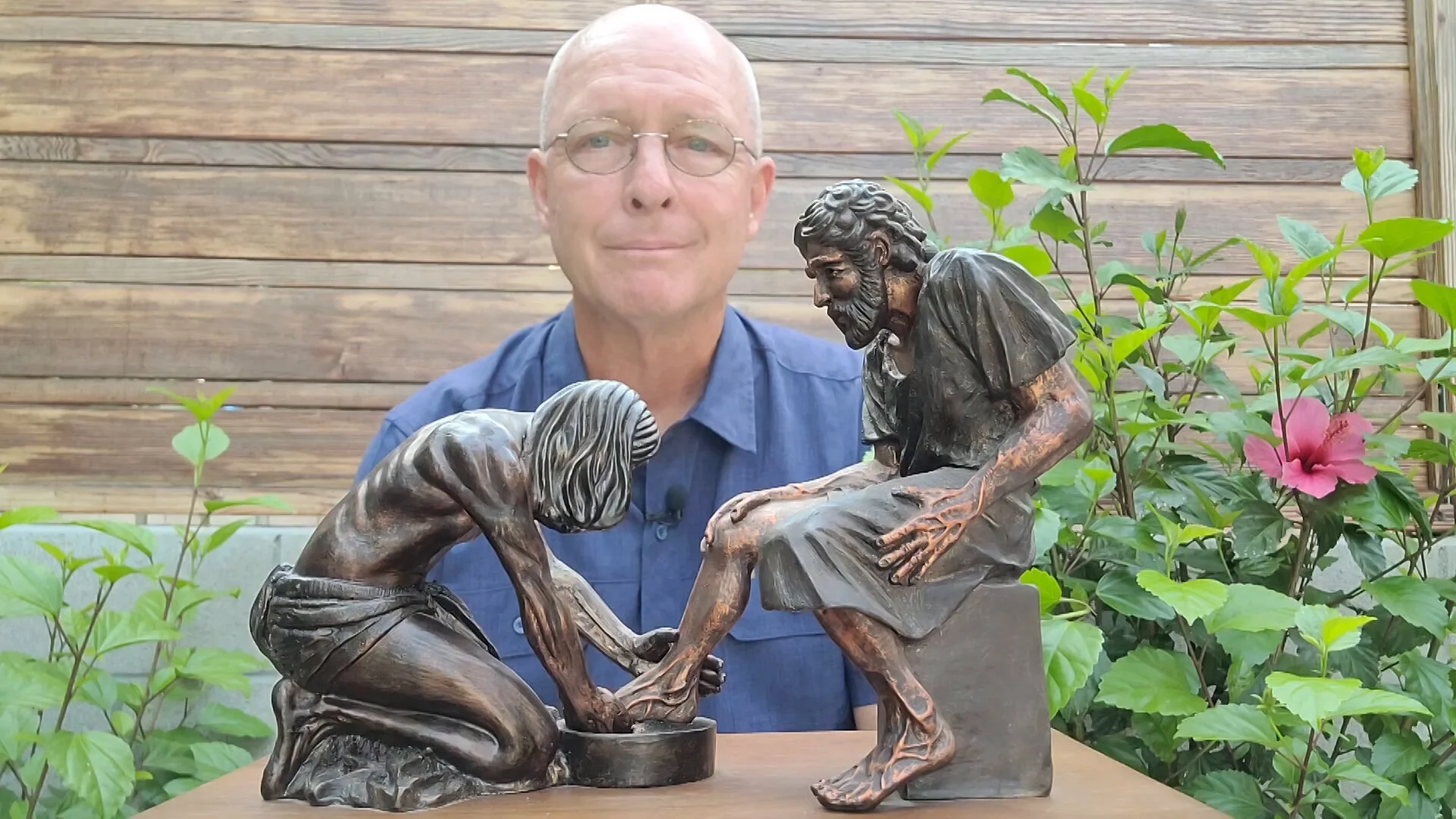
It’s likely, based on his startled response, that Peter was the first of the Twelve the Lord approached with his wash basin. And since their conversation is the only one recorded, it’s easy to imagine the rest of the disciples as so overwhelmed with reverence for their master’s stunning humility, they were simply speechless. I picture the Lord quietly bending before each of them one by one within an awestruck silence broken only by the sound of splashing water as they experienced him doing the unimaginable.

There’s so much we don’t know. We don’t know how long he spent with each of them individually, what was communicated in his eye contact, or what tenderness was expressed in his touch. But we do know he expected them to serve others in the same way he’d served them. We know this because he said so. John 13:12-17 tells us after he’d finished, put his outer garments back on, and returned to his place at the table, he explained he wasn’t just trying to impress them with his humility. He was setting an example he wanted them to follow.

And I can’t imagine any scenario where that expectation of his first followers doesn’t apply to those of us who’ve come along later. We need to be cautious about how we proceed with our lives after this scriptural encounter with Jesus on his knees. The shadows of our self-centeredness cannot remain in the brilliant light of his others-centeredness. We can never again excuse ourselves from fulfilling the Lord’s command to do as he did.

In the final verse of this section, Jesus concluded this profound lesson on the servant-heartedness of his kingdom. And he said something unexpected. He said if we know these things and do them, WE are blessed. And that word blessed literally means happy. In other words, he was saying our personal happiness is linked to putting others first. But I don’t believe he was trying to incentivize servanthood. He was neither saying that happiness would be withheld from us as punishment unless we change our behavior nor that we will be rewarded with it if we do. He was just making clear that the path to life as he intended is always in his footsteps. Since we were created in his image, whenever we follow his example in anything, we find ourselves experiencing the life we were made for. And there’s no greater joy than that.

Among the most pleasurable experiences of my life have been the times I’ve been able to volunteer with a ministry called, Laundry Love (laundrylove.org). It’s a group of people around the country seeking to brighten the lives of low-income families and individuals by helping pay for them to get their clothes washed. All it required of me was to withdraw some quarters from my bank, drive to a laundromat in a part of town I don’t usually frequent, meander among the washers and dryers, greet the folks I encountered with a friendly smile, and offer to put some coins in the machines for them. But the joy of making even a small difference in the constrained budgets of these dear people in the name of Jesus is amazing. In fact, every time I’ve worked with Laundry Love I’ve felt guilty for how good it made ME feel. And if you’ve ever been blessed with the opportunity to serve others, you know what I mean.

We were made for this. And there are literally countless opportunities in this world for us to follow our Lord’s example of humble servitude. So, if you desire to experience greater happiness in your life, grab your wash basin. And if there aren’t any feet that need washing, maybe wash someone’s clothes instead.

John 13:6-11 • Verbally Processing

Imagine how you’d react if the Queen of England showed up at your home for afternoon tea, and before you’d even begun to adjust to the realization you had royalty under your roof, she got up from her seat, tied an apron around her waist, and proceeded to make your bed, dust the furniture, clean your toilet, take out the trash, and give your dog a bath. How unthinkable, shocking, and embarrassing would that be! What would you say? Where would you begin?

That example doesn’t even come close to what the disciples experienced as their master, the Messiah, took on the role of a servant and began washing their feet. And John 13:6-11 records Peter’s clumsy, awkward, and inelegant words as he was verbally processing his way through this disorienting episode and trying to make sense of what was happening. But the passage also includes the Lord’s patient replies, and they teach us how to better handle those times when he’s up to things in our lives we don’t yet comprehend.

When Jesus approached him with his wash basin, Peter’s first reaction was to question the appropriateness of what the Lord was doing. The original Greek is very emphatic. He asked him, “Are YOU washing MY feet?” And if you’ve ever been so perplexed by what the Lord seemed to be doing you found yourself challenging his wisdom, I’ll bet you can relate. I know I can.

Isaiah 55:9 tells us that God’s ways and thoughts are higher than ours. And we need his to be. So, it makes sense that there would be times we’d have trouble comprehending his actions. But the Lord’s response to Peter was both comforting and encouraging. He said, "What I am doing you do not understand now, but you will know after this." And with that statement he was both expressing sensitivity to Peter’s confusion as well as promising to eventually make things clear. And that assurance is for us too.

Peter’s second reaction was unequivocal. He said, “You shall NEVER wash my feet!” But Jesus said, “If I do not…you have no part with me.” And although he was referencing the spiritual cleansing symbolized by the feet washing, he was saying the depth of Peter’s relationship with him was at stake in this.

Have you ever been bewildered by the Lord’s actions or inaction in a situation and found yourself entertaining the thought that a good God would NEVER allow this to happen? Well, the truth is, sometimes he must allow us to experience things we may not understand exactly because he cares so much about our relationship with him. And his willingness to do that despite the confusion it may cause is really one of the greatest expressions of his love. In those times, we need to let go of our insistence he do what we think he should and allow him to draw us closer to himself instead.

Peter’s third reaction was to tell Jesus what more he should be doing. He said, “Lord, not my feet only, but also my hands and my head.” Does that sound familiar? It saddens me, but I admit there have been times when I’ve accused my Savior of doing less than what the situation called for. The Lord’s reply to Peter was, “He who is bathed needs only to wash his feet.” And those words were meant to assure him he was doing no less than exactly what was needed. And that’s always true for all of us all the time.

The dialog in this section of the chapter concludes with Jesus drawing a clear distinction between Peter and Judas. And I have a hunch he did that specifically to reassure Peter that verbally processing his confusion was not considered a betrayal of his faith but a confirmation of it. So, let’s take comfort in what that means for us too.

John 13:4-5 • The Things Servants Do

My friend, Bobby Chance, really bugs me. We met in the mid 1970’s when we were members of a Christian rock band touring the U.S. and Canada sharing our faith through music. When that ministry concluded, he returned to his home state of Texas and began a business career. But a few years later, all that changed when he sensed God calling him to take the gospel to the streets. So, he quit his job, relocated his family to inner-city Los Angeles, and has been extending the love of Jesus to the homeless, addicted, trafficked, and forgotten in the heartless urban centers of the world ever since. And every time I try to settle into my comfortable suburban fortress insulating me from all that pain, the image of him running toward it deeply troubles me in a very good way.

Servant-heartedness is a way of being that is completely out of sync with this sin-scarred world where the arc of human activity is bent toward selfishness. So, the account of Jesus, in purposeful humility, washing his disciples’ feet is jaw-dropping in terms of its dissonance with our lived experience. People just don’t naturally prioritize the needs of others. The Lord was modeling a different way to be human – the way of the redeemed. He was providing a glimpse into a born-again personhood where we’re free and empowered to become more like him and less like us.

His extraordinary example was clearly meant to disturb the disciples and to set them up to embrace more of what it looks like to be a citizen of the kingdom his resurrection would soon inaugurate. And since our faith in him escorts us into that same kingdom, I think it’s obvious Jesus meant this episode to shake us up a bit too. It’s not until our fistfuls of old-creation expectations are jarred loose that we have the capacity to lay hold of new-creation understandings.

We’ve already considered some of these. In John 13:3, we encountered Jesus showing us the things servants know. And now, let’s look at his actions in verses 4 and 5 to learn about the things servants do.

First, by the simple act of rising from supper to serve, he showed us that servants balance receiving with giving. I’m not talking about physical food, but if there’s no input, there can’t be any output. If our serving isn’t nourished by feasting, we’ll soon burn out with nothing to offer anyone. On the other hand, if our sole focus is sating our own appetites, we’ll become spiritually obese. We need to ensure that we spend appropriate time at the table of self-care so we can offer ourselves to others sacrificially in a spiritually healthy and sustained way.

Second, when Jesus laid aside his outer garments, wrapped himself in a towel, poured water into a basin, and began washing feet it wasn’t something exotic. This service would have been offered as a matter of course by the household staff had he and his disciples not been forced to celebrate Passover in a borrowed room. What made it so shocking was not what was happening but who was doing it. The Lord was demonstrating that servants don’t concern themselves with seeking jobs that match their personal skillset, preferences, or sense of self-importance. They simply find a need and fill it. Most of the time, ministry is just about doing what needs to be done with a grateful and humble heart.

Third, when Jesus dried his disciples’ feet with the towel he was wearing, he was illustrating that servants absorb stuff. All of us engaged in caring for the needs of others will find ourselves dealing with the dirt people pick up along life’s journey. And some of it’s going to end up on us. This isn’t something to dread, resist, or complain about. This is one of the privileges of serving Jesus. We need to make sure we never get confused about who the real savior is, but while representing him, if we get the chance to take one for the team, how awesome is that!

I’ve got a long way to go, but I want to become the kind of person whose servant-heartedness evidences a new-creation way of being human, reflects Jesus better, and disturbs people in a really good way. If that mirrors your own desires, join me in prayerfully inviting the Lord to help us do the things servants do.

John 13:3 • The Things Servants Know

The sight of the Son of God on his knees washing his disciple’s feet depicted in John chapter 13, is one of the most shocking discoveries any reader of this Gospel will experience. It seems to arrive so suddenly that after you encounter it, you find yourself asking, “Where did that come from.” So, you circle back to try and grasp what you just read and find that verse 3 provides context for the Lord’s actions in verse 4, but those actions – rising from supper, removing his outer garments, and wrapping himself in a towel – don’t at first seem to be related to that context. So, when you arrive at verse 5, you’re completely unprepared for its dramatic depiction of such unimaginable and disorienting humility.

And it’s not only a staggering moment for those of us who observe this event on the pages of Scripture from the distance of millennia, it was far more so for the disciples who lived it firsthand, especially Peter. It takes another 12 verses of the Lord’s responses to Peter’s startled reactions before he and the rest of the Twelve begin to regain their footing and for the significance of what just happened to start to come into focus.

We need a similar debriefing by the Holy Spirit if we’re going to be able to take in its impact, and I plan to pursue that with you. But right now, I’d like to focus on verse 3 and the three things it tells us Jesus knew that made possible the kind of holy servanthood he displayed. If we’re ever going to serve others with the same heart he has – which was clearly his point – we need to know what he knew.

First, it says he knew, “that the Father had given all things into his hands.” He had nothing to lose. We’re often hesitant to serve others for fear of what it will cost us emotionally or in terms of time and money spent. But when we understand, as Jesus did, that we already possess the full measure of God’s favor and provision, we can give of ourselves to others with confidence that doing so can’t diminish us. God has fully resourced us with all we could ever need.

Second, we’re told he knew, “that he had come from God.” He had nothing to prove. His serving was a settled response to a divine assignment. He didn’t need to wash feet as a way of validating that. When we serve as a means of affirming our calling instead of from a place of confidence in it, our service is self-serving and becomes polluted. But when our missional activity flows from a solid assurance that we’ve been sent by God to tangibly express his love in this world, it changes why we serve and what people experience from us when we do.

Finally, the text tells us he knew that he, “was going to God.” He had nothing to earn. His eternity was already secure. When we seek to gain God’s favor through acts of service, it betrays an insecurity regarding our relationship with him and becomes all about us instead of all about those we’re supposed to minister to in his name. Our faith in Christ is what has settled our eternal destiny, not our works. We will be with him forever, and nothing we may attempt to do for him can add anything to what he’s already done to secure the fulfillment of that promise.

The image of the Messiah stooping over a water basin to clean road dirt from his followers’ sandaled feet is breathtaking. It stands in stark contrast to the world’s sin-distorted concepts of authority. But God is inviting you and me to make his model more commonplace as we follow our Lord’s example. He calls to us from Philippians 2 verses 5 and 7 where it says, “Let this mind be in you, which was also in Christ Jesus, who...made Himself of no reputation, taking the form of a bondservant.”

Let’s take up his challenge by welcoming him to teach us the things servants know.

John 13:1-2 • A Zero-Sum Game

I experienced something of an emotional crisis during my wife’s second pregnancy. It didn’t last, but it was very real. Over a period of several days, I found myself nearly overcome with fear that I wouldn’t have the capacity to love our second child. I think I knew better, but I imagined my love as a limited resource that had already been fully invested in our firstborn. And now, I was afraid there would be nothing left to offer her sibling. But thankfully, it wasn’t long before I discovered that parental love is not a zero-sum game where someone can win only if someone else loses. It’s as though something opens up in the hearts of moms and dads that taps into a limitless reservoir. And I’ve come to understand that that something is a gift from God that reflects how he loves all of us equally.

Having completed his ministry to the crowds as well as his debates with the religious leaders, the thirteenth chapter of John’s Gospel launches the section that reveals Jesus fully focused on the cross and preparing his disciples for what would follow. It strategically provides details regarding this season of the Lord’s ministry that the earlier-written, synoptic Gospels don’t. And it begins with a moving account of the master washing his disciples’ feet that results in a vivid lesson on servanthood. But the first two verses set the stage for that episode by giving us a majestic description of the love that motivated Christ’s mission set against a backdrop of the sinister satanic maneuverings at work to stop it.

The Passover feast was approaching. It was the final one Jesus would celebrate with his disciples – The Last Supper, as it would come to be known. And although the Lord was keenly aware his crucifixion was imminent, instead of turning inward to brace himself for the impending suffering, verse 1 tells us that “having loved his own who were in the world, he loved them to the end.”

At the point when anyone else would have become self-absorbed, he continued to focus his loving attention on others. Yes, the text clearly refers to the Twelve. But if we stop to consider who these men were, we can easily locate ourselves in their company and hear these life-giving words as an expression of the Savior’s heart for everyone.

These weren’t stained-glass saints whose holiness merited special affection. Within hours, Peter would deny he ever knew Jesus. James and John were impulsive and arrogant. Bartholomew was prejudiced against Galileans. Matthew was a white-collar criminal, Thomas a skeptic, and Simon a political revolutionary. And then there’s the ultimate villain of the Gospel narrative: Judas. Verse two makes clear that among those Jesus would love to the end was a man who by the time the seder meal was served that evening had already embraced a Satan-inspired determination to betray him to the Jewish authorities.

If that couldn’t disqualify someone from the steadfast love of Christ, nothing can.

Even if our theology is better than this, many of us subconsciously believe God’s love is a limited resource, and he manages it by giving more or less of it to certain people based on the worthiness of their piety. But none of us deserve God’s love. Romans 3:23 plainly states we’ve all sinned and fallen short of God’s standards. And yet Romans 5:8 says, “God demonstrates His own love toward us, in that while we were still sinners, Christ died for us.”

His is a limitless love that envelopes each of us equally in its embrace. A love that 1 Corinthians 13:8 tells us will never fail. So, if you’ve marginalized yourself in terms of how you imagine the quality and quantity of the love God has for you, think again. His Father-love is not a zero-sum game.

John 12:44-50 • A Call to Faith

The last seven verses of John 12 conclude Jesus’ public preaching. Afterward, he would spend his remaining time prior to the cross focused on preparing the disciples for their future ministries. So, in this final discourse to the crowds, he passionately raised his voice and issued one last call to faith.

He started off by clarifying that to believe in him meant believing in the one who’d sent him. Then, he reminded them of the three things he’d done to help them do that. He’d shown them what the Father is like, reflected his light into their darkness, and declared to them his words warning that those words would one day serve as their judge if they rejected him.

And with that, it was over. There was just no more to say. It was time for them to make their choice and he left them to it. But I’m deeply intrigued by that succinct-yet-profound, three-fold description of the Lord’s ministry and how it impacts all of us.

First, he showed us what the Father is like. We don’t have to wonder or guess. The maker and master of all things pressed his glory into human flesh and lived among us (John 1:14) putting his love, wisdom, power, authority, tenderness, kindness, and holiness on display. God is not a philosophy to be debated, a concept to be shaped, a mystery to be solved, or a mythology to be embellished. He has a very real and indelible face, name, and history in Jesus of Nazareth. And although he’s infinitely greater than flesh and blood could ever contain (Romans 11:33; 1 Timothy 6:16), the incarnation made it possible for him to be seen, touched, followed, studied, emulated, and ultimately believed on with a faith anchored in facts (1 John 1:1-3).

Second, he reflected the Father’s light into our darkness. He made it possible for us to recognize our need. We’re so accustomed to and enveloped by the inky depths of our sin that we’re unaware of our spiritual blindness until the shining example of the righteousness of God in Jesus breaks through revealing the impassible chasm between us and him. But then, like a rising sun illuminating a new day (Luke 1:78), Jesus also reveals the bridge across that divide opened for us through his love and sacrifice.

Finally, he declared the Father’s words to us. He made it possible for us to hear God. Through the things Jesus said, the folly, distortions, lies, and deceptions that poison, ruin, and enslave us are exposed and undone as God’s truth sets us free (John 8:32). His teachings also inspire, instruct, nourish, and guide us. But his words not only contain the power and wisdom of God, they reveal his heart. In them, we hear the sound of his voice.

When someone speaks, they’re engaged in two streams of communication at once. There’s what they say and how they say it. The first stream provides the informational content, the second supplies the relational context. And we all know what it’s like when they don’t match, when what’s said informs but wounds in the process. But the words of Jesus always contain divine truth wrapped in the love of God. Even when his message seems confrontive and hard to receive, we always hear the unmistakable sound of our loving Father speaking life to us and caring enough to say what we need to hear.

The Lord’s final public sermon was a call to faith. And an exploration of what he said that day elicits a response too. It’s just not possible to leave a consideration of the wonder of these three aspects of his life and ministry without ourselves being drawn to a fresh expression of belief that results in a renewal of devotion. Let’s offer him both.

John 12:42-43 • It Shouts into Our Doubts

Even though the previous section stated that many of the people who witnessed Jesus’ miracles made the choice not to believe in him as Messiah, John 12:42 reveals that there were many who did, including some among the Jewish ruling class. But we’re told they didn’t want to make their faith public because they were afraid of being excommunicated. Then verse 43 adds this: “They loved the praise of men more than the praise of God.”

Part of me would prefer that sentence wasn’t in the Bible at all, but I especially wish there was a way to avoid reading it in its context because this is not a description of those who’d rejected Christ. This exposes something ugly in the hearts of believers. And since I happen to be one of those, I can’t just ignore this passage. I need to stop and search the recesses of my own soul with a willingness to answer the question of whose opinion matters to me. I need to confront the issue of whose favor I’m seeking.

Excommunication was no joke. It literally meant becoming “unsynagogued,” expelled from nearly everything that defined Jewishness. But for those leaders, it wasn’t just about what they were afraid of losing if they went on the record with their belief. The text indicates their main interest was in what they thought they could gain by keeping their faith private.

It’s described as “praise,” which is a translation of a word meaning opinion or estimation. In other words, they wanted others to have a good opinion of them, to be esteemed, held in high regard, respected. And they thought they could achieve that best by holding their faith in Jesus close to the vest.

If I’m honest, I have to confess that I’ve been guilty of this approach in the pursuit of affirmation. There’ve been times when I’ve chosen to veil my Christianity to gain a higher ranking in the opinion of unbelievers I wanted to impress. On those occasions, I told myself I wasn’t really denying my faith, I just wasn’t volunteering it. I even justified what I was doing by convincing myself I’d be in a better position to share my testimony once I’d gained the favor I sought.

But as sinful as all that is, the real issue here is not about whether I’m always upfront with my beliefs, it’s about the foolishness of seeking the approval of the world. The affirmation I seek cannot be gained from people. The favor of others is fickle, shallow, and fleeting. The only opinion of my worth that can truly satisfy my soul’s longing is God’s.

The Greek word translated as “loved” in this passage is the verb form of “agape.” And the New Testament uses it almost exclusively to describe the love of God – the love that he has for us, that we offer back to him, and that we extend in his name to others. So, when we’re told “They loved the praise of men,” it indicates that they were seeking something from people that can only be received from God. It’s his opinion of us that matters.

But maybe the reason I seek the approval of others is that I’m so deeply aware that I don’t deserve his. Can you identify with that? If so, let’s remind each other that there’s a blood-stained cross emphatically declaring for all time how much he values us. It shouts into our doubts his affirming love.

John 12:37-41 • Beyond Observing to Seeing

Is it possible for someone to observe something but make the choice to not see it?

I’m a Star Wars fan and have a prized collection of memorabilia that people have given me over time. But when we relocated to Southern California after retiring, my compilation remained in a moving box in our garage for a couple of years. Then, some of our grandchildren came for a visit and wanted to see it. So, we spent a couple of enjoyable hours unpacking, viewing, discussing, and playing with my souvenirs.

Afterward, instead of putting everything back in storage, I decided to find a way to display the items in the house. But I had to come up with a plan for doing it that wouldn’t conflict with the ambience of my wife’s carefully crafted interior design. So, I made the decision to build a special shelf for them above my desk in the small room the two of us share as an office.

Now, you have to understand, it’s a tiny space with our desks facing opposite walls and only three feet apart. And when I started my project, Sue was at her desk working on her laptop editing a new book she’d just written. Admittedly, it wasn’t an ideal time for me to be measuring, drilling, hammering, and arranging my display just 36 inches away. But she was so focused on her work and blocked what I was doing out of her mind so effectively that it wasn’t until weeks later when our grandkids were visiting again and pointed out to her the result of my labors that she finally saw my Star Wars shelf.

Like the dust bunnies under the bed we’ve ignored for so long that we no longer see them, if we make the choice to not see something, we can reach a point where we can’t see it. And this type of willful disconnect with reality is what’s being described in John 12:37-41.

This passage sadly reports that most of the people who’d witnessed the many miraculous signs Jesus performed made a conscious choice not to believe. And it quotes two Old Testament prophecies from Isaiah addressing this. The first one (Isaiah 53:1) predicted that people would observe the “arm” or power of the Messiah but choose not to acknowledge his divinity. The second one (Isaiah 6:9-10) said that because they would make the choice to not see, they would enter a state where they wouldn’t be able to see, and tragically, be unable to receive the spiritual healing being offered.

I’m a Jesus-follower and have been most of my life. I chose to see him with eyes of faith and receive his saving grace long ago. But salvation is not the only aspect of my relationship with him that requires a willingness to see.

For instance, to benefit from the work of his Spirit addressing my destructive habits and behaviors means first being willing to stop ignoring or excusing them and acknowledge them as sin. Until I confess or see them for what they are, I won’t cooperate with his sanctifying work. And the longer I close my eyes to this reality, the closer I get to not being able to even recognize my need. James 1:22-24 describes this as self-deception that’s like viewing ourselves in a mirror but walking away without taking action on what we’ve seen and forgetting what we really look like.

The Christian life requires moving beyond observing to seeing. But we can always do so without fear. The light Jesus uses to reveal our spiritual imperfections in that mirror is the same light he uses to transform them. So, I invite you to join me today in claiming the promise of 2 Corinthians 3:18. “But we all, with unveiled face, beholding as in a mirror the glory of the Lord, are being transformed into the same image from glory to glory, just as by the Spirit of the Lord.”

John 12:35-36 • The Brilliant Glow of Belief

Last summer, my wife and I went for a bike ride along the beach near our home to a restaurant for dinner. After we finished our meal, we realized we’d lost track of time and the sun was setting. That meant we'd have to make much of the ride home in the dark, and we hadn’t thought to bring headlamps or flashlights. So, we found ourselves in a precarious situation. It was difficult to see where we were going and to avoid colliding with obstacles in the bike path. After making it home, we decided that in the future we’d stick to doing our bike riding in daylight.

Jesus used a similar illustration as he spoke to the crowd in John 12:35-36. He ignored the question they posed in the previous verse when they asked, “Who is this Son of Man?” He’d already addressed that issue with them on several occasions. So, instead of engaging in another attempt to explain his messianic mission, he chose instead to address the root cause of their failure to comprehend it.

They didn’t need more information. They needed to make a choice.

He told them it was time to walk in the light they’d already received. And since he’d twice previously described himself as “the light of the world” (John 8:1; 9:5), they’d have understood what he meant. It was time to step forward and begin their faith-journey while he was still present to illuminate the path. But he told them that wouldn’t be much longer. Unless they began advancing into the brilliant glow of belief, they’d soon find themselves groping in the dark.

Then, he added this mind-bender. He said if they would place their faith in the light, they would become its offspring. What did he mean by that? Well, again, the crowd would’ve understood he was referencing himself. So, they wouldn’t have missed his meaning. He was inviting them to become his children by placing faith in him as their messiah and promising if they did, his light would become more than an external phenomenon. It would become their identity.

Then, to illustrate the urgency of what he’d just said, we’re told he departed from them and concealed his whereabouts. Although he’d likely just gone back to Bethany for the night, it was a dramatic way to leave his audience considering the impact of his message.

I think this passage leaves us in the same state, pondering how to respond to its truth. And it’s clear this is about more than just our initial step from darkness into light, that moment we first cross from doubt into belief. It’s about every step of faith that follows that one.

As we live our lives in pursuit of Christ, we’ll frequently find ourselves entering pools of his illumination as we face circumstances, read his word, or hear the voice of his Spirit pointing the way forward into new dimensions of trust. On those occasions, it’s not usually more information we need, it’s a choice we need to make. And the time to make it is while Jesus is lighting it up because there’s often a time limit on those moments of his revelation.

You may be experiencing one right now. If so, I challenge you to stop hesitating and step forward with faith that the light of the world is not only with you to lead the way but to deepen your identity as his child.